
Good Event Technology Starts With Better Conversations: Why We Run Focus Groups
Good Event Technology Starts With Better Conversations: Why We Run Focus Groups
Good Event Technology Starts With Better Conversations: Why We Run Focus Groups
At JET, we’ve always believed the best event technology isn’t built in isolation.
You can have a roadmap. You can have a product vision. You can have a strong internal team making smart decisions. But if you’re not regularly sitting down with the people actually using the platform – the organisers dealing with real-world pressure – you will miss things.
That’s why we create structured moments to listen and learn.
We speak to organisers all the time – during implementation, in support conversations, after event handovers – and every one of those conversations adds colour to our understanding of how events really run.
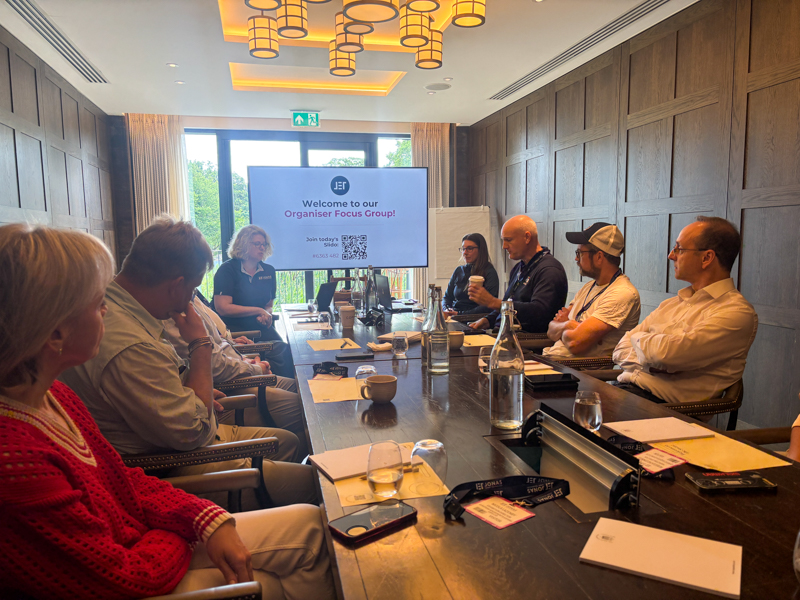
But there’s a different quality to the insights you hear when organisers are together, talking through challenges and experiences in dialogue, rather than in isolation. That’s what focus groups enable.
The value of real conversation over surface data
A focus group isn’t just a group meeting. In research terms, it’s a method designed to elicit rich qualitative insight – the kind you simply can’t capture with surveys or usage metrics alone.
The group dynamic allows participants to explore their own experiences, challenge assumptions and reveal nuances in how they think and act that wouldn’t come out in one-to-one feedback or quantitative data.
In our context, that means hearing not just that organisers value a feature but why they rely on it under pressure, how their teams justify certain workarounds and where the real tension points sit when timelines are tight or expectations are high.
This kind of insight gets to how, why and in what context organisers make decisions – and that’s the thinking that leads to better product outcomes and better support.
Understanding pressure, not just preference
There’s a real difference between what people say they want in theory and how they behave in practice. Focus groups help bridge that gap by creating a setting where organisers describe real scenarios, not hypothetical ones.
They surface:
- The language organisers actually use when under pressure.
- How teams prioritise tasks when event day is looming.
- The trade-offs between making something simpler versus making something reliable.
This maps directly to how we design support and guidance, how we prioritise workflows and how we help organisers avoid friction during critical moments.
In market research, this kind of qualitative approach is recognised precisely for its ability to tap into why people think and act the way they do – not just what they report.
Early listening prevents late firefighting
One of the biggest advantages of these structured conversations is timing.
By listening early in the process – before features are finalised, before workflows are widely adopted – we can validate assumptions and highlight divergence points that might otherwise only become apparent through frustration on the ground.
It isn’t just about discovering what people want. It’s about confirming why they want it, and whether that desire sits across enough use cases to justify building it in a particular way. That depth of understanding can save weeks of rework or confusion later, precisely the kind of thing organisers care about when they’re already juggling deadlines.
That’s real customer success in practice – proactively reducing friction rather than reacting to it.
A two-way commitment
Because organisers are generous with their time, it’s important that the process is respectful and purposeful.
Focus group conversations are collaborative dialogues. Some of the most valuable moments come when one participant’s experience prompts another to reflect in a way they hadn’t before. That’s exactly the group effect researchers talk about when they describe focus group interactions as greater than the sum of their parts.
And it’s not just us listening. It’s organisers hearing from each other – giving them broader context, new perspectives and sometimes reassurance that their challenges are shared, not unique to them.
Anchoring technology in real outcomes
The pressures facing organisers aren’t the same across every event.
A large trade show brings scale, complexity and flow challenges. Conferences demand precision, data clarity and a carefully managed attendee experience. Consumer events move fast, with high volumes and little tolerance for friction.
Different events bring different pressures, but all of them are shaped by decisions made long before doors open.
By bringing organisers from different formats into the same conversations, we’re able to understand where those pressures overlap. That insight helps us shape how our platform is configured, supported and applied for different event types, rather than forcing everyone into the same approach.
It also helps us guide organisers more effectively. Not just on what the platform can do, but on what actually makes sense for their specific event, audience and commercial goals.
That’s the difference between providing software and being a delivery partner.
An open invitation
As we plan our next round of focus groups, the aim stays the same – to keep listening, keep learning and keep building a platform shaped by the realities organisers face every day.
If you run trade shows, conferences or consumer events – and you care about improving how registration, data and onsite delivery actually work in practice – we’d love to have you involved.
Because good event technology is built through conversation.
Interested in taking part in a future focus group? Speak to your usual JET contact or get in touch with our team to find out more.